

Favorites: Movies
My favorites from the silver screen, the drive-in wall, and the BluRay player...
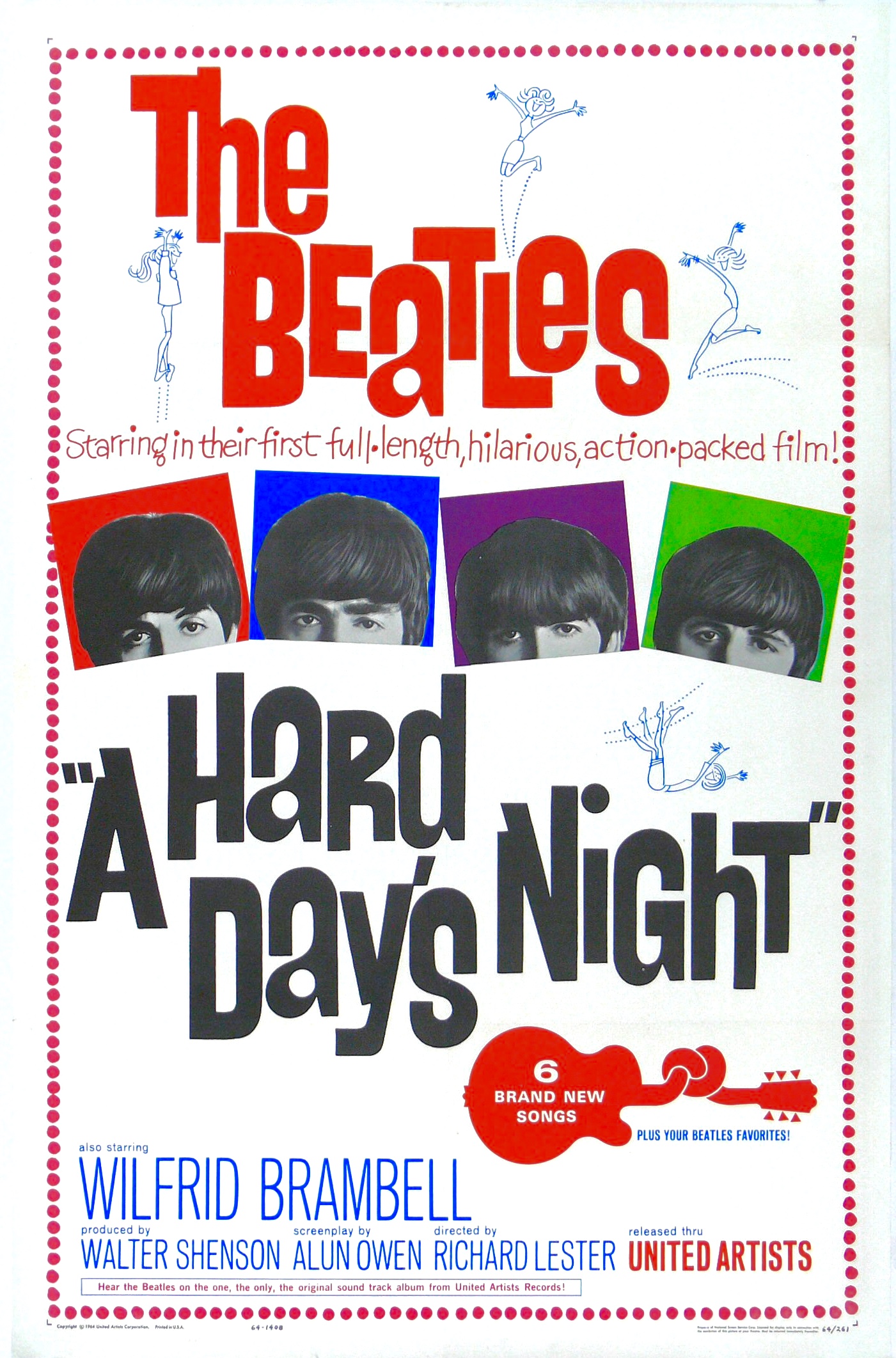
A Hard Day's Night (1964)
Director: Richard Lester
Actors: John Lennon, Paul McCartney, George Harrison, Ringo
Starr
Studio: United Artists
Richard Lester's 1964 film A Hard Day's Night completely revolutionized the architectural framework of musical cinema. Bypassing the stiff, theatrical conventions of traditional rock-and-roll movies — and thus, surpassing any expectations of the film being a quick-buck cash-in, Lester injected the frantic, documentary-style camera work and rapid-fire editing techniques of the French New Wave. Working from a brilliant, highly cynical script by Alun Owen, the film perfectly captures the razor-sharp, working-class wit of John, Paul, George, and Ringo as they navigate the surreal, suffocating chaos of Beatlemania. From a structural standpoint, the film's highly stylized, fast-paced musical segments — most notably the chaotic field sequence for "Can't Buy Me Love" — served as the undisputed blueprint for the modern music video. Anchored by the band's effortless, natural charisma and a flawless soundtrack, it remains a wildly entertaining, flawlessly executed piece of 1960s pop-culture machinery.
Malcolm X (1992)
Director: Spike Lee
Actors: Denzel Washington, Angela Bassett, Delroy Lindo, Al Freeman
Jr.
Studio: Warner Bros.
A towering, uncompromising biographical epic, Spike Lee's 1992 masterpiece Malcolm X is an absolute triumph of cinematic architecture. Rather than relying on standard documentary pacing, Lee and cinematographer Ernest Dickerson constructed highly distinct visual palettes to map the profound evolution of the civil rights leader. The film seamlessly transitions from the hyper-kinetic, warm-toned dance halls of Malcolm Little's street-hustling youth, into the stark, cold-blue isolation of his prison awakening, and finally out into the sweeping, sun-drenched reality of his pilgrimage to Mecca. This massive structural framework is flawlessly anchored by Denzel Washington's legendary lead performance. Bypassing mere imitation, Washington completely internalizes the fiery cadence, intellectual friction, and immense spiritual weight of the icon. Bolstered by an incredible supporting cast including Angela Bassett and Delroy Lindo, it stands as a brilliantly paced, fiercely vital monument of 1990s filmmaking that effortlessly sustains its massive, three-hour runtime. What wasn't sustainable for me, however, was waiting to see the movie on the big screen. When most multiplexes were gladly hosting the film upon its initial release, the main cinema in my area (The Church Hill Cinema, long defunct and replaced by a Chinese buffet) decided to wait until May of 1993 to devote a week of screentime to the film — someone in charge apparently wasn't initially keen on showing this movie in a predominantly white town, even though, thanks to conscious hip-hop acts like Public Enemy and BDP, the main audience for it, younger white adults who saw the area's racism as the bullshit that it was (and still is), it attracted a good crowd anyway. This quite frankly, is the movie Denzel should have gotten his first Best Actor Oscar for — portraying an iconic hero, rather than the loathsome bad cop in the otherwise fine vehicle Training Day.
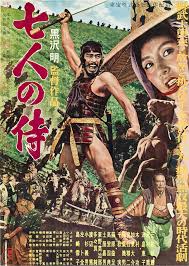
Seven Samurai (1954)
Director: Akira Kurosawa
Actors: Toshiro Mifune, Takashi Shimura, Keiko Tsushima, Seiji
Miyaguchi
Studio: Toho
An undisputed, foundational pillar of global cinema, Akira Kurosawa's 1954 epic Seven Samurai permanently forged the architectural blueprint for the modern action film. Single-handedly establishing the "assembling the team" narrative framework, Kurosawa paired his deeply philosophical storytelling with groundbreaking technical engineering. By pioneering the use of multiple telephoto cameras during combat sequences, the director successfully captured the chaotic, visceral reality of 16th-century warfare while maintaining incredibly strict, disciplined actor blocking. This kinetic visual mastery is perfectly showcased in the torrential, mud-soaked climax. The film's sprawling framework is anchored by the brilliant, deeply contrasting character dynamics of its leads: Takashi Shimura's stoic, heavily grounded performance as the veteran leader Kambei serves as the perfect counterbalance to the feral, highly unpredictable physical energy of Toshiro Mifune's Kikuchiyo. Clocking in at over three hours, it remains a flawlessly paced, monumental achievement in tension, combat mechanics, and emotional depth.
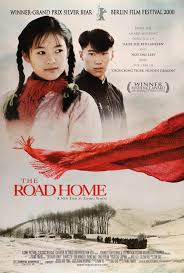
The Road Home (1999)
Director: Zhang Yimou
Actors: Ziyi Zhang, Sun Honglei, Zheng Hao, Zhao Yulian
Studio: Guangxi Film Studio / Columbia Pictures Film Production
Asia
A profoundly intimate and visually staggering cinematic achievement, Zhang Yimou's 1999 masterpiece The Road Home completely re-engineers the traditional structural mechanics of the romance genre. The film's brilliance lies heavily in its innovative visual architecture: it boldly reverses standard cinematic conventions by rendering the cold, grief-stricken present in stark, monochromatic black-and-white, while the flashbacks of the parents' courtship explode into a hyper-saturated, incredibly vibrant color palette. This mechanical choice perfectly elevates the warmth and overwhelming power of memory, making the past feel fiercely alive. Anchoring this sweeping rural landscape is a legendary, career-launching debut performance from Ziyi Zhang. Bypassing heavy dialogue, she drives the narrative entirely through radiant, deeply expressive physicality, whether standing silently in the freezing snow or sprinting across breathtaking autumnal fields in her iconic red jacket. It remains a flawlessly constructed, deeply emotional tribute to the enduring nature of love and tradition.
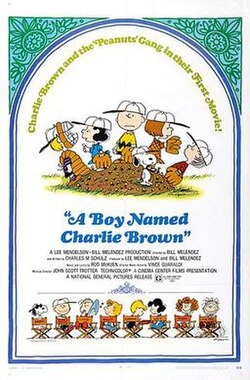
A Boy Named Charlie Brown (1969)
Director: Bill Melendez
Actors: Peter Robbins, Pamelyn Ferdin, Glenn Gilger, Bill
Melendez
Studio: Cinema Center Films / National General Pictures
A bold, visually staggering expansion of a beloved comic universe, the 1969 feature film A Boy Named Charlie Brown successfully transitioned the Peanuts gang to the silver screen by completely re-engineering their traditional aesthetic. Director Bill Melendez actively bypassed the minimalist, flat architecture of the television specials, opting instead to inject the theatrical runtime with fiercely experimental visual effects. The animation serves as a brilliant time capsule of the era, heavily borrowing from the 1960s pop-art movement to deliver dizzying, psychedelic sequences and surreal, highly saturated color grids—techniques that were shockingly avant-garde for a children's film and rarely attempted in the franchise again. This highly stylized, kaleidoscopic framework perfectly contrasts with the deeply grounded, existential narrative of Charlie Brown's high-stakes journey to a national spelling bee. It stands as a flawless, structurally daring piece of cinematic pop-culture that proves even the most familiar characters can thrive inside a wildly innovative visual machine.
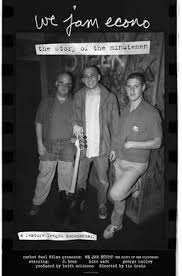
We Jam Econo: The Story of the Minutemen (2005)
Director: Tim Irwin
Actors: D. Boon, Mike Watt, George Hurley
Studio: Rocket Fuel Films / Plexifilm
A profoundly moving and fiercely essential historical document, Tim Irwin's 2005 film We Jam Econo: The Story of the Minutemen serves as the undisputed blueprint for the American DIY underground. The documentary meticulously tracks how childhood friends D. Boon, Mike Watt, and George Hurley completely re-engineered the architectural mechanics of punk rock. Bypassing traditional aggression, the trio constructed a highly disciplined, blindingly fast, and heavily jazz-inflected sonic grid built entirely on extreme working-class efficiency. However, for those with a direct, personal connection to the surviving rhythm section, the film completely transcends standard rock documentary tropes. It shifts into an incredibly intimate, deeply emotional family portrait, highlighting the unvarnished reality of their unbreakable brotherhood in San Pedro. Driven by breathtaking archival live footage and deeply personal interviews, it remains a flawless, heartbreaking tribute to the towering legacy of D. Boon and the absolute purest definition of independent music machinery.
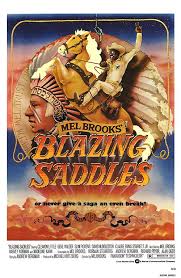
Blazing Saddles (1974)
Director: Mel Brooks
Actors: Cleavon Little, Gene Wilder, Harvey Korman, Madeline
Kahn
Studio: Warner Bros.
An endlessly quotable, brilliantly subversive comedic wrecking ball, Mel Brooks' 1974 masterpiece Blazing Saddles completely dismantled the traditional, mythic architecture of the American Western. Working with a legendary writing room that included Richard Pryor, Brooks engineered a highly unstable, fourth-wall-breaking cinematic environment that operates simultaneously on two distinct levels. On the surface, it functions as a highly aggressive, razor-sharp satire that eviscerates Hollywood racism through legendary gags like the heavily timed tollbooth and the bell-censored arrival of the Sheriff. Yet, beneath the adult-oriented wordplay and brilliant character subversions — such as Madeline Kahn's legendary Marlene Dietrich spoof — the mechanical framework of the film is pure, unadulterated slapstick. Relying heavily on cartoon logic, culminating perfectly in the explosive "Candygram for Mongo" sequence punctuated by the literal Looney Tunes theme, it functions as a high-velocity, live-action animation. It remains a deeply deceptive, chaotic triumph that flawlessly hijacked a classic genre and permanently altered the landscape of cinematic comedy.
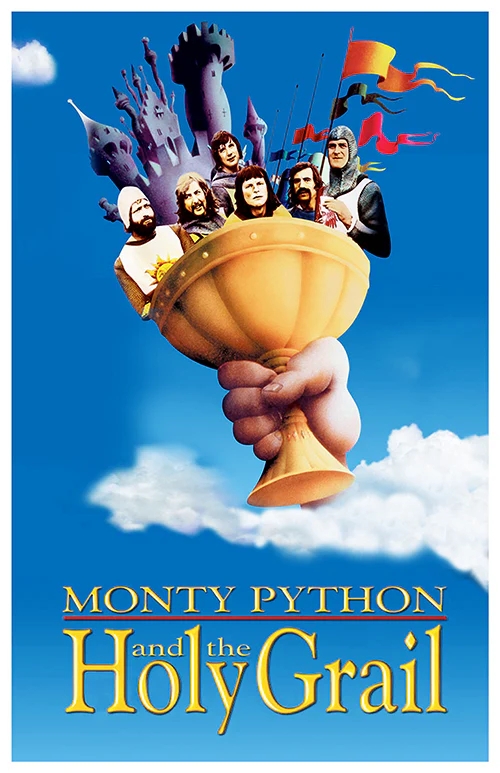
Monty Python and the Holy Grail (1975)
Directors: Terry Gilliam, Terry Jones
Actors: Graham Chapman, John Cleese, Terry Gilliam, Eric Idle,
Terry Jones, Michael Palin
Studio: Python (Monty) Pictures / EMI Films
A structurally anarchic, endlessly quotable triumph of British surrealism, the 1975 comedy Monty Python and the Holy Grail fundamentally demolished the highly rigid, self-serious architecture of the medieval epic. Working with a fiercely restricted budget, directors Terry Gilliam and Terry Jones brilliantly weaponized their limitations, engineering iconic, DIY audio gags like utilizing clapping coconut shells in place of actual horses. Narratively, the film completely bypasses a traditional three-act structure. Instead, it plays out exactly like a beautifully derailed tabletop role-playing campaign, where the strict grid of Arthurian legend is constantly hijacked by absurd tangents, killer rabbits, and fourth-wall-breaking police investigations. The film's absolute mastery of pacing is perfectly distilled in the legendary Black Knight sequence, where catastrophic, limb-severing damage is confidently dismissed as "'Tis but a scratch!" It remains a wildly unstable, brilliantly engineered comedy engine that forever altered the global comedic landscape.

Other People's Money (1991)
Director: Norman Jewison
Actors: Danny DeVito, Gregory Peck, Penelope Ann Miller, Piper
Laurie
Studio: Warner Bros.
An absolute masterclass in ruthless corporate machinery and razor-sharp dialogue, 1991's Other People's Money operates as a brilliant, high-velocity collision of ethics and greed. Director Norman Jewison perfectly pits the ultimate avatar of Wall Street cynicism—Danny DeVito delivering an iconic, scenery-chewing performance as "Larry the Liquidator"—against Gregory Peck's deeply principled, old-school industrialist patriarch. As DeVito engineers a hostile, predatory takeover of a struggling New England wire and cable company, Penelope Ann Miller steps onto the grid as the brilliant, high-powered lawyer hired to completely jam the gears of his financial wrecking ball. The resulting dynamic is a fierce, highly entertaining boardroom war fueled by unadulterated capitalism, dark humor, and relentless, fast-talking swagger.

Yojimbo (1961)
Director: Akira Kurosawa
Actors: Toshiro Mifune, Tatsuya Nakadai, Yoko Tsukasa
Studio: Toho
1961's Yojimbo — one of Akira Kurosawa’s many masterpieces — is the foundational blueprint for the modern action film. Toshiro Mifune delivers an impossibly cool, career-defining performance as Sanjuro, a masterless samurai who strolls into a desolate town actively tearing itself apart through a war between two rival crime syndicates. Rather than acting as a standard, noble hero, Sanjuro operates as a cynical, highly calculated wrecking ball. He systematically dismantles the town’s corrupt machinery by playing both factions against each other with ruthless, razor-sharp precision. Featuring breathtaking, high-velocity swordplay and a deeply atmospheric, dust-choked visual grid, the film’s structural DNA was so indestructible that Sergio Leone famously lifted it frame-for-frame to build the Spaghetti Western genre with A Fistful of Dollars. (Personally, I think Clint Eastwood's The Man With No Name would not have survived a one-on-one confrontation with Mifune's Sajuro.) It is a vital, uncompromising masterwork of cinematic violence and unadulterated swagger.

Tougher Than Leather (1988)
Director: Rick Rubin
Actors: Joseph "Run" Simmons, Darryl "DMC" McDaniels, Jason "Jam
Master Jay" Mizell, Richard Edson, Rick Rubin
Studio: New Line Cinema
An underrated slice of raw, unadulterated hip-hop swagger, 1988's Tougher Than Leather is the exact moment where the machinery of the 1980s music industry violently collided with the cinematic grid. Directed by Def Jam co-founder Rick Rubin (who was a film major in New York University when he started the iconic label out of his dorm room), this glorious, blown-out B-movie serves as a direct, high-velocity homage to the gritty blaxploitation revenge films of the 1970s. It drops Run-D.M.C. — operating at the absolute zenith of their global power — into a chaotic plot to dismantle a corrupt, murderous syndicate of record executives. It completely ignores traditional cinematic conventions in favor of serving as a fiercely entertaining, action-packed vehicle for the reigning kings of rap. Packed with cameos from the Beastie Boys and legendary Def Jam personnel, it is a vital, uncompromising time capsule of New York hip-hop culture carrying some very heavy firepower.

There Will Always Be An England (2008)
Director: Julien Temple
Actors: John Lydon, Steve Jones, Paul Cook, Glen Matlock
Studio: Fremantle Media
The direct-to-DVD 2008 concert film There Will Always Be An England captures the undisputed architects of British punk rock proving their machinery hasn't rusted a single bit. Directed by legendary punk documentarian Julien Temple (who also helmed the band's previous two cinematic efforts, the Malcolm McLaren-revisionist The Great Rock n' Roll Swindle and the band's later and more honest The Filth and the Fury), this vital concert film documents the Sex Pistols' incendiary 2007 reunion run at London's Brixton Academy, marking the 30th anniversary of Never Mind the Bollocks. Rather than playing out like a standard, going-through-the-motions nostalgia act, the band attacks the grid with terrifying, high-velocity precision. The foundational rhythm section of Paul Cook and Glen Matlock is locked in flawlessly, driving the massive, roaring engine of Steve Jones's guitar architecture. At the absolute center of the chaos, John Lydon commands the stage as a deeply cynical, intensely charismatic ringmaster. It is a brilliant, uncompromising victory lap that proves the original punk rock wrecking ball still hits with devastating structural force.

The World at War (1973)
Producer: Jeremy Isaacs
Narrator: Laurence Olivier
Studio: Thames Television
This is actually a documentary series, not a movie per se, but I'm throwing it in here rather than do a favorite TV shows page (it would be a very short list) just to put this there — besides, most of these episodes run feature-length to begin with. Thames Television's 1973 documentary series The World at War easily transcends the standard cinematic grid to stand as the definitive audiovisual record of global conflict. Produced by Jeremy Isaacs, the series was engineered with a staggering sense of urgency, capturing incredibly raw, direct interviews with the actual surviving architects, soldiers, and victims of World War II's brutal machinery (it was the early 70's, so they had to work fast). Anchored by the chilling, gravitas-laden narration of Laurence Olivier and a deeply haunting score, it carries an unmatched narrative weight. Encountering a massive historical document like this as a kid is a formative experience; it successfully ignites a profound, lifelong fascination with the era's history, brilliantly commanding respect and attention without demanding a descent into the hyper-nerdy, textbook-quoting fanaticism of standard war buffs. It is a vital, heavy, and completely unshakeable piece of television.

Plan 9 From Outer Space (1959)
Director: Edward D. Wood Jr.
Actors: Gregory Walcott, Tor Johnson, Vampira, Bela Lugosi
Studio: Reynolds Pictures
A monument to sheer, unadulterated cinematic audacity, Ed Wood’s 1959 sci-fi/horror hybrid Plan 9 From Outer Space stands as the ultimate monument to enthusiastic failure. Widely canonized as the worst movie ever committed to celluloid, yet beloved by a large cult audience, its structural grid is a magnificent, blown-out disaster. Wood engineered this machinery with zero budget and absolute sincerity, building his vision upon paper-plate flying saucers dangling from visible strings, wildly incoherent day-to-night continuity errors, and the profoundly tragic, spliced-in final footage of the late Bela Lugosi. Yet, beneath the completely collapsed narrative architecture and deeply bizarre, stilted dialogue, there lies a relentless, bulletproof passion for the art of filmmaking. It operates entirely outside the standard rules of cinema, achieving legendary cult status simply by refusing to understand its own limitations. And let's not forget the infuence it had on the likes of Glenn Danzig (who named his Misfits-era record label Plan 9 and wrote the song "Vampira" about the iconic B-movie hostess/actress) and Tim Burton (who made a biopic about Ed Wood that depicts in part the making of this movie) It is an essential, fiercely entertaining piece of B-movie infrastructure.

M (1931)
Director: Fritz Lang
Actors: Peter Lorre, Otto Wernicke, Gustaf Gründgens
Studio: Nero-Film AG
When building a collection of movies on DVD and BluRay, having Fritz Lang's 1931 masterpiece M on the shelf is absolutely non-negotiable. As Lang's first sound film, it is practically the foundational blueprint for the modern psychological thriller. The way he weaponizes audio — specifically Peter Lorre’s chilling, off-screen whistling of "In the Hall of the Mountain King" to signal his presence — is pure, terrifying genius. Lorre's breakout performance as the hunted child killer is completely mesmerizing, peaking with that sweaty, frantic monologue where he begs for his life before a kangaroo court made up of the city's criminal underworld. Drenched in heavy German Expressionist shadows and sheer paranoia, it's an incredibly dark, masterful piece of cinema that still hits like a sledgehammer almost a century later.

All the President's Men (1976)
Director: Alan J. Pakula
Actors: Robert Redford, Dustin Hoffman, Jason Robards, Hal Holbrook
Studio: Warner Bros.
I have always had a deep fascination with the entire Watergate saga, which makes having Alan J. Pakula's 1976 masterpiece on the shelf an absolute necessity. It is the ultimate journalism thriller. What makes this film so brilliant is that we already know exactly how the story ends, yet the tension is still completely suffocating. Watching Robert Redford and Dustin Hoffman as Woodward and Bernstein pound the pavement, hammer away at typewriters, and chase down terrified informants (Hal Holbrook as Deep Throat [Mark Felt]) in deeply shadowed parking garages is just mesmerizing. It perfectly captures the gritty, exhausting, and completely unglamorous shoe-leather work of analog investigative reporting. Elevated by Jason Robards's legendary, Oscar-winning performance as editor Ben Bradlee and Gordon Willis's stark, paranoid cinematography, it is a flawless, methodical procedural that never loses its edge.